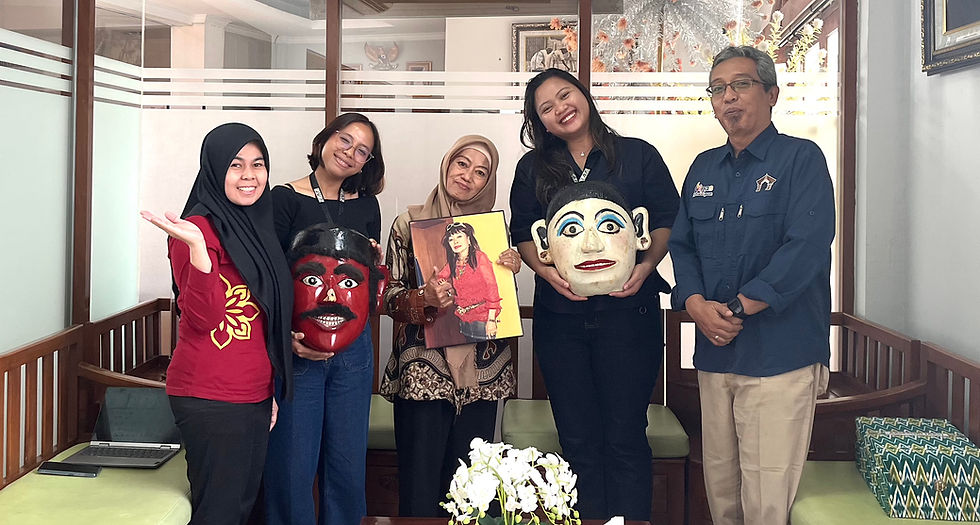
Jimmy & Dewi: Legendary Betawi Ondel-Ondel
Apr 16, 2026
Who doesn’t know ondel-ondel? Ondel-ondel are giant puppets that are an iconic part of Betawi culture, adorned with traditional bridal clothing and accessories. These puppets generally stand around ±2.5 meters tall and are made with lightweight structures, allowing a person inside to carry and move them.
At Betawi Museum, ondel-ondel are preserved in the form of masks named Jimmy and Dewi, names personally given by Mpok Nori. These objects were donated by the iconic Betawi artist, who was widely known for her role in the TV series “Pepesan Kosong” as a trendy grandmother with a iconic “rocker” voice.
Betawi Museum itself is part of the Betawi Cultural Village Management Unit under Jakarta’s Cultural Office, located in Setu Babakan, South Jakarta. By 2024, the museum had around 520 recorded collection objects, documented since 2016. These collections reflect various aspects of Betawi life, including household tools, wedding traditions, and performing arts.
Some of the museum’s collections come from government institutional assets, while most were donated by cultural figures, including Ibu Ema Agus Bisri, Bapak Buchori, Sanggar Tari Mak Manih, and Pak Udin.
The History and Story Behind Ondel-Ondel
Ondel-ondel reflect the Betawi worldview, symbolizing harmony, balance, and equilibrium through the pairing of male and female figures.
In the past, ondel-ondel had a sacred function as protectors against misfortune and evil spirits. They were paraded around villages accompanied by offerings and incense as part of protective rituals. Their creation also involved special ceremonial stages known as ngukup or ukup. In practice, ondel-ondel were believed to embody ancestral spirits who protected communities from danger.
Over time, the function of ondel-ondel shifted. They became more commonly associated with wedding processions, performing arts, and as cultural icons in Betawi celebrations across Jakarta. However, they are also often used in traveling street performances.
Betawi Facial Representation in Jimmy and Dewi
Before being donated to the museum, Jimmy and Dewi originally had full body frames (cages) and were displayed in front of Sanggar Sinar Noray, owned by Mpok Nori.
Mpok Nori’s closeness to the two masks was reflected not only in their creation process, but also in the way she cared for them. “Yes, these were Mak Aji’s (Mpok Nori’s) favorites,” said Mpok Engkar.
The pair was made at Mpok Nori’s request, as she wanted to have personal ondel-ondel figures that represented Betawi identity. The design was created by one of her close friends, while the facial details were painted directly by Mpok Nori together with her youngest daughter, Mpok Engkar.
“Well, when it came to painting details like this (the face), that was me. The maker only did the basic shape. Since it was already old, I ended up fixing it up and dressing it again. I added green,” added Mpok Engkar.
Dewi was styled with bridal makeup that, at the time, was deliberately bold. Bright blue eyeshadow, arched eyebrows, and red lips with a subtle smile were all chosen directly by Mpok Nori and Mpok Engkar. Dewi’s face was also said to resemble Mpok Nori herself.
In contrast, Jimmy features a firm and fierce facial expression, marked by a moustache, thick eyebrows, and the peci cap he wears. These characteristics reflect the style of ondel-ondel from the past, which differs from today’s versions that tend to have softer facial features.
“And this moustache was attached by us too. We were the ones who put it on. Nowadays it’s probably much neater, but Jimmy’s was still made from ijuk (palm fiber),” said Mpok Engkar.
Symbolically, Jimmy’s red face represents courage and strength to ward off evil spirits or disease outbreaks. Meanwhile, Dewi’s white face symbolizes purity, kindness, and the peace that comes after misfortune has passed.
Jimmy and Dewi were not merely performance props, but were treated and cared for like children by Mpok Nori. During her lifetime, the two masks were even bathed regularly once a year as a form of affection and care.
“They said the ondel-ondel should be bathed? I said, ‘Well, they’d smell! Once a year, poor things,’” added Mpok Engkar.
This two masks were also once used in traveling performances accompanied by Betawi music, long before Mpok Nori became widely known as a comedian and actress.
Getting to Know a Betawi Cultural Icon: Mpok Nori
Mpok Nori, whose full name was Hj. Nuri Sarinuri binti Keenan, was born in Depok on August 10, 1930. She was known as a comedian and lenong performer who became a Betawi cultural icon through her dedication to the performing arts.
As a child, she had dreamed of becoming a nurse. However, this dream did not come true because her parents encouraged her to remain in the arts. Mpok Nori was the daughter of rebab and drum musicians who formed a Betawi mask performance group called Gang Makyong. From them, she inherited the mission of keeping Betawi culture alive.
At the age of 14, she decided to leave school and focus on helping her family’s arts business. Her artistic journey began as a Ronggeng Topeng dancer, which she learned from her mother. In Betawi mask performances, Ronggeng usually performed alongside Bodor, a male comedic character.
Over time, comedy was no longer exclusively performed by men. Women were also expected to deliver humorous dialogue to complement the bodor. This is where Mpok Nori began developing her comedic talent and eventually became known as a Betawi female comedian. She also studied under Na’ih bin Dji’un, the older brother of Bokir and father of Mandra.
Her name rose to wider fame through the TV series Pepesan Kosong (1993–1995), alongside Malih Tong Tong and Bolot. She became known for her iconic role as a trendy grandmother with a iconic “rocker” voice. This image remained attached to her in various later roles, including in film “Cinta 24 Karat” and many others across genres.
Mpok Nori also served as a guest lecturer at Jakarta Arts Institute in 1988–1989. She taught the basics of topeng dance, which were then developed into new creative Betawi dance forms.
In addition to acting and teaching, she expanded her work by founding a Betawi lenong studio in 1993. After surviving the economic crisis, the studio was renamed Sanggar Sinar Noray in 2000.
At the studio, various Betawi art forms were taught to younger generations, from topeng dance and lenong to gambang kromong. After Mpok Nori passed away in 2015, the studio was continued by her youngest daughter, Engkar Karmila Sari.
Jimmy and Dewi were often used in neighborhood parades from the Sinar Noray studio to enliven different events. For Mpok Nori, they were never just props, but like “children” who needed care. This is why Mpok Engkar felt it was important to donate them to the Betawi Museum so they could be preserved and introduced to younger generations.
Accessing the Collection Through Jakarta Digital Collections (Koleksi Jakarta)
Stories of other Betawi Museum collections will also be available through the Jakarta Digital Collections (Koleksi Jakarta) portal, which is planned to launch in mid-2026.
Koleksi Jakarta is an initiative by SEAMS through #KoleksiKita program, in collaboration with Jakarta’s Cultural Office and 12 museums under its management. The program aims to expand public access to museum collections through digitization and cataloging.
This initiative is supported by the U.S. Ambassadors Fund for Cultural Preservation (AFCP), which is committed to supporting the preservation of historic buildings, archaeological and cultural sites, museum objects and collections, and traditional cultural expressions in countries around the world.