Cataloging Training #KoleksiKita Continues at Museum Bahari
Feb 18, 2026
The #KoleksiKita cataloging training aimed at strengthening museum capacity in collection documentation and preservation was once again held at Museum Bahari on Wednesday, February 18, 2026.
As a program focused on enhancing documentation and the digitization of museum collections, #KoleksiKita, in collaboration with the Dinas Kebudayaan Provinsi DKI Jakarta, plans to launch Jakarta Digital Collections (JDC) in mid-2026.
This digital portal will serve as an online platform providing public access to museum collections. Therefore, the cataloging training serves as a crucial foundation to ensure that the data presented is accurate, structured, and systematically organized.
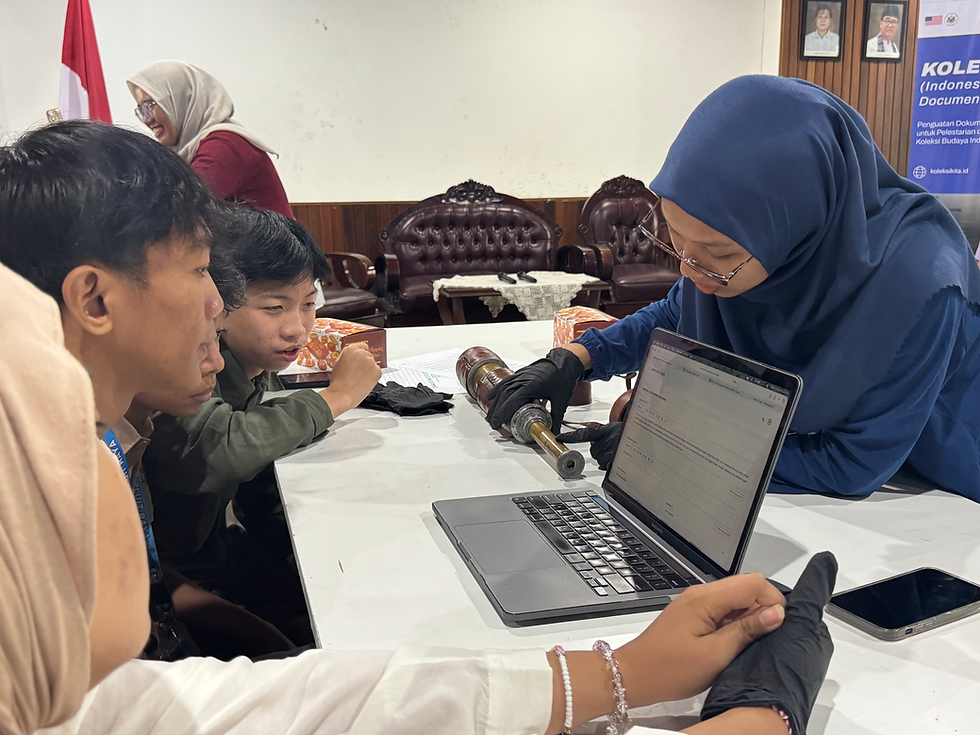
Held at the Ir. Djuanda Hall of Museum Bahari, the activity was attended by ten participants from Museum Bahari and Museum Onrust. The session began with an introduction to the #KoleksiKita program and an overview of its objectives, followed by object discussions and hands-on cataloging practice conducted in groups.
Museum Bahari houses approximately 800 collection objects, including traditional ship equipment, original traditional boats, miniature boats from Indonesia and abroad, marine life specimens, diorama sculptures, and historical artifacts such as cannons, anchors, lighthouses, and telescopes.
Meanwhile, Museum Onrust holds 354 collection objects, consisting of ceramics, architectural fragments such as bricks and floor tiles, as well as structural remains from the Dutch VOC colonial era. Its collections also include metal artifacts such as keys, nails, and various utility tools.
During the workshop session, participants learned the complete workflow of collection documentation, from object handling and detailed visual and material observation to compiling the collection’s provenance.
They were also trained to complete essential elements in the cataloging form, including object photographs, identification numbers, ownership information, object type, physical description, production methods, materials, condition reports, and supporting documentation.
Cataloging is a technical process of systematically organizing and describing collections so that they can be identified, traced, and easily accessed. This process includes classification, indexing, and the preparation of collection metadata for documentation and public use.
Three Maritime Collections in the Cataloging Practice
The training not only covered theory but also involved direct practice with selected collection objects. Three items were chosen as representatives: a long telescope, a kempis fish trap, and a sextant.
The long telescope is a navigation instrument made of yellowish-gold metal that was historically used by sailors to observe conditions ahead of and around the ship while sailing, including distant navigational objects.
Kempis is a bamboo-woven fish trap used in estuarine waters. Crafted using traditional weaving techniques, it reflects local coastal knowledge in utilizing natural materials such as rattan and bamboo. In addition to the kempis, the museum houses 23 other fishing tools, including scoop nets, cast nets, fish traps (lukah), handlines, spears, and fish cages.
A sextant is an astronomical navigation instrument used to measure the angle between celestial bodies and the horizon. It was commonly used by large ships sailing across the ocean before entering Sunda Kelapa Port. The sextant in this collection was manufactured by H. Hughes & Son in 1920 and is made of metal with a wooden support, equipped with a magnifying lens to read measurement degrees.
Historically, Museum Bahari was located in a major trading hub for commodities. Navigation instruments such as the sextant therefore played a vital role in ensuring the safe arrival of cargo ships. Together, these three objects represent the diverse navigational and fishing equipment once widely used across the Nusantara region, although often known by different names in different areas.
As a follow-up to the training, 70 selected objects, including miniature ships, fishing tools, boat-making equipment, and others, will begin to be cataloged and digitized by SEAMS through #KoleksiKita from February to March 2026. Similar activities for Museum Onrust will commence in April 2026.
Through this initiative, museums are expected to further strengthen their skills in recording and tracing collection provenance. The resulting data will be made available to the public through the Jakarta Digital Collections platform.
The #KoleksiKita team also implements international cataloging standards such as the Getty Vocabularies (AAT, TGN, ULAN) and the Library of Congress Subject Headings (LCSH) to enhance the quality of documentation, preservation, and accessibility of collections.
This activity is supported by the U.S. Ambassadors Fund for Cultural Preservation (AFCP), which is committed to safeguarding historic buildings, archaeological sites, cultural objects, museum collections, and traditional cultural expressions such as language and music in partner countries worldwide.